
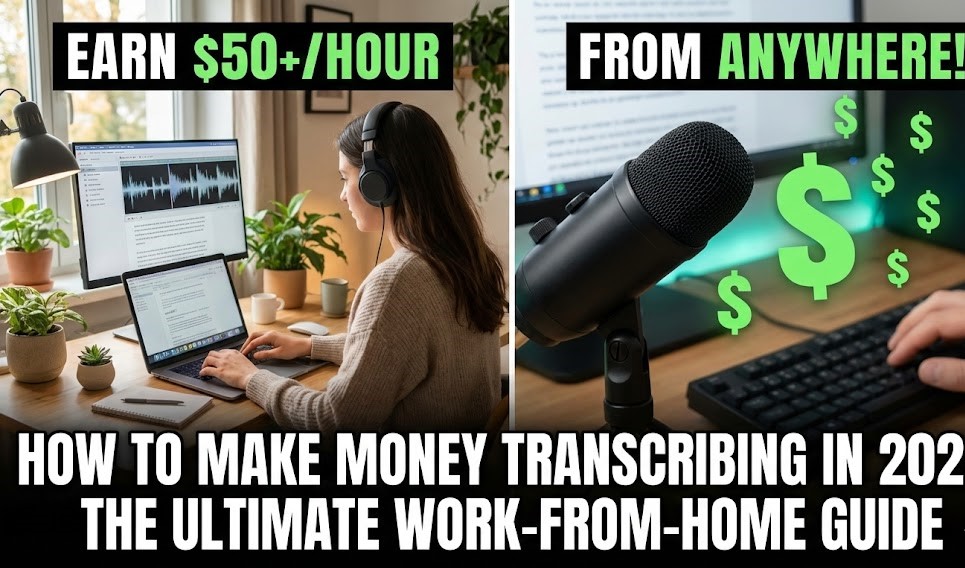
Are you a bit of a whiz when it comes to spelling and grammar? Looking for a flexible gig to fit around your studies, your family, or your travels?
There are plenty of part-time jobs out there to help with the rising cost of living, but not all of them will fit seamlessly into your schedule. Transcribing is one of the ultimate flexible side hustles. Most platforms allow you to choose as few or as many hours as you want, and you can do it all from your couch—cutting down on miserable commutes or late-night rides home from a shift.
But let me be completely candid: transcription isn’t a get-rich-quick scheme. It takes patience, a sharp ear, and fast fingers. If I’ve piqued your interest, read on to find out the ins and outs of becoming a transcriber in 2026, and how to maximize your earnings.
What is Transcription?
Transcription is simply the process of converting an audio or video recording into written text.
This could be any kind of recording, but common examples include interviews, university lectures, medical dictations, corporate meetings, TV programs, or podcasts. As a transcriber, you listen to a recording and accurately type out exactly what is said, occasionally adding timestamps or speaker tags.
It sounds pretty simple, right? Well, for the right person, it absolutely is.
What Skills Do You Need to Become a Transcriber?
Before you dive in, let’s check if you have the baseline skills required to actually make this profitable:
- Fast Typing Speed: Time is money. Transcription jobs are paid per audio minute, not by the hour. If you type slowly, your hourly wage will plummet. In 2026, the industry standard to be profitable is a typing speed of 60+ words per minute (WPM). If you aren’t quite there yet, practice on sites like TypingTest.com to build your muscle memory.
- Active Listening: You aren’t just getting the “gist” of a conversation; you are singling out every single word. If your mind wanders, your accuracy drops, and platforms will reject your work.
- Good Comprehension: You will encounter thick accents, muffled audio, background noise, and people talking over each other. You need the deductive reasoning to decipher what is being said in tough audio environments.
- Flawless Grammar and Punctuation: You must know where commas belong and the difference between their, there, and they’re. Using a tool like Grammarly is a great backup, but you need a strong foundational knowledge of English formatting to succeed.
- Self-Motivation: You are your own boss. There is no manager breathing down your neck, which means you need the discipline to sit down, remove distractions, and get the job done.
Where to Find the Best Transcription Jobs in 2026
If you are ready to start testing your skills, here are the top platforms currently hiring freelance transcribers:
1. Rev
Rev is one of the biggest names in the industry. You sign up, take a grammar quiz, and submit a sample transcript. Once approved, you have access to a massive dashboard of jobs. Transcribers typically earn between $0.30 and $1.10 per audio minute and are paid weekly via PayPal.
2. TranscribeMe
TranscribeMe is highly flexible and perfect for beginners. Instead of transcribing hour-long files, their system feeds you bite-sized 2-to-4-minute audio clips. General transcribers start at $15 to $22 per audio hour, with advancement opportunities (like joining their medical or legal specialty teams) paying up to $70+ per audio hour.
3. Upwork
Unlike agency sites, Upwork is a massive freelance marketplace where you bid on independent contracts. While you have to pitch yourself to clients and pay Upwork a service fee, you can set your own rates. Experienced transcriptionists on Upwork frequently charge between $17 and $25+ per real-time hour.
4. HappyScribe
A great modern alternative that blends AI and human transcription. HappyScribe caters heavily to media projects, subtitling, and translation. You take a rigorous test to join, but they are known for an excellent interface and steady workflow.
5. GoTranscript
GoTranscript is very welcoming to beginners. Every transcript you submit is rated by an editor. As your accuracy rating goes up, you get access to higher-paying audio files. They pay an average of $0.60 per audio minute.
The Reality Check: How Much Do Transcribers Actually Make?
Here is where I need to be brutally honest: an “audio hour” is not the same as a real-time hour. If a platform pays $20 per audio hour, that does not mean you are making $20 an hour. For a beginner, it typically takes 3 to 4 hours of real-time work to transcribe 1 hour of audio. Therefore, your actual starting wage might look closer to $5 to $7 an hour until you get faster.
Experienced transcribers who utilize text-expanders and foot pedals can get that ratio down to 2:1 (two hours of work for one hour of audio), significantly boosting their take-home pay.

What Equipment Do You Need?
At a bare minimum, all you need is a laptop and a stable internet connection. However, if you want to turn this into a lucrative side hustle, investing in the right gear is non-negotiable:
- Noise-Canceling Headphones: You will frequently receive low-quality audio files. Good over-ear headphones will save you from straining to hear whispered words over background static.
- A Transcription Foot Pedal: This is the secret weapon of the pros. A foot pedal plugs into your computer via USB and lets you play, pause, and rewind audio with your foot. This keeps your hands glued to the keyboard, massively speeding up your WPM.
- Ergonomic Keyboard: You are going to be typing a lot. An ergonomic setup helps prevent repetitive strain injuries like carpal tunnel syndrome.
The Benefits of Being a Transcriptionist
Despite the learning curve, transcription remains incredibly popular for several reasons:
- Total Flexibility: You work strictly to your own schedule. Want to transcribe at 2:00 AM? Go for it.
- Zero Commute: You can do this from your living room, a coffee shop, or while traveling the world as a digital nomad.
- Learn Fascinating Things: One minute you might be transcribing a true-crime podcast, and the next, a fascinating university lecture on astrophysics.
- CV Builder: It demonstrates extreme attention to detail, strong language skills, and the ability to meet strict deadlines—traits every employer loves.
Also Read : How to Make Money Selling Your Hair in 2026: The Ultimate Guide
