
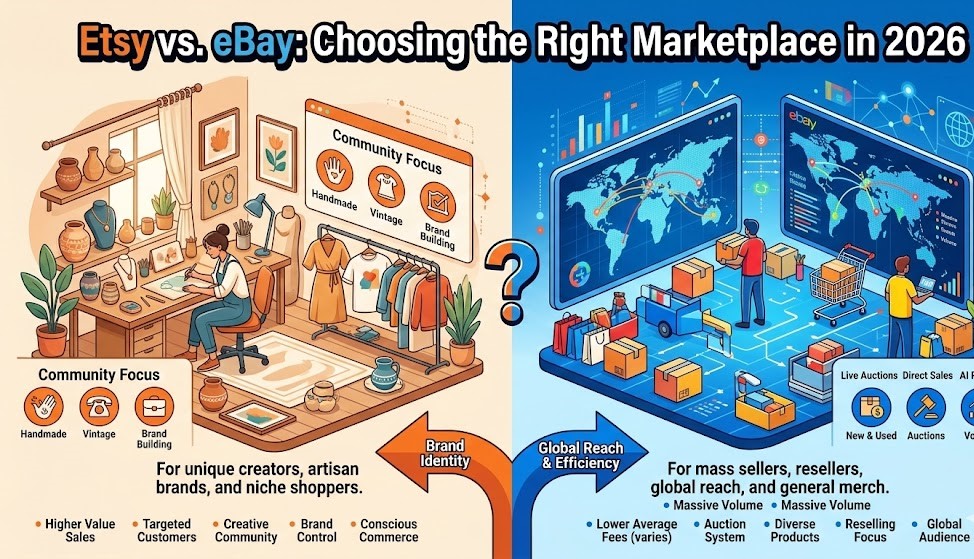
With retail eCommerce sales projected to hit $8.1 trillion in 2026, the rivalry between Etsy and eBay is more relevant than ever. Choosing between these two giants is a pivotal decision for any entrepreneur. While both offer a gateway to millions of global shoppers, they cater to very different business models, product types, and growth strategies.
Whether you are an artist creating one-of-a-kind handmade goods or a retailer looking to scale a massive inventory, here is the straightforward, no-nonsense breakdown of how these platforms stack up in today’s market.
At a Glance: Etsy vs. eBay Quick Comparison
| Feature | Etsy | eBay |
| Active Buyers | ~96 Million | ~132 Million |
| Best For | Handmade, Vintage, Craft Supplies. | Everything (Electronics, Parts, Fashion). |
| Ease of Use | High (Clean, simple interface). | Moderate (Feature-rich but cluttered). |
| Starting Fees | $0.20 per listing. | 250 Free listings/month (Basic plan). |
| Scalability | Small to Medium businesses. | Small to Enterprise retailers. |
A Detailed Breakdown for 2026 Sellers
1. Product Focus: Where Does Your Item Fit?
The “vibe” of your product determines your success.
- Etsy is the digital home for the unique and the personal. If you sell jewelry, wedding decor, or personalized gifts, Etsy’s audience is specifically looking for you.
- eBay is a global catch-all. While vintage items do sell here, the platform is dominated by electronics, automotive parts, and mass-market fashion.
2. Pricing & Fees: The Bottom Line
Understanding your margins is critical.
- Etsy Fees: You’ll pay a $0.20 listing fee and a 6.5% transaction fee on the total sale (including shipping). For most small-scale creators, this is the most predictable and lowest overall cost structure.
- eBay Fees: While they offer 250 zero-insertion-fee listings per month, their “Final Value Fee” can be higher, often reaching up to 15% depending on the category.
3. Design & Customization
How much control do you want over your “brand”?
- Etsy provides a clean, artistic template. It’s professional but offers limited branding unless you use Etsy Pattern to build a separate website.
- eBay allows for more robust store categorization. For high-volume sellers, the eBay Store subscription provides a unique URL and a more traditional storefront experience.
4. SEO & Visibility
- Etsy SEO relies heavily on keywords, tags, and “recency.” It is highly visual and rewards sellers who use descriptive, long-tail keywords.
- eBay SEO uses the Cassini engine. It rewards more than just keywords—it looks at your seller performance, return policies, and how quickly you respond to buyers.
Pros and Cons: Which One Should You Choose?
Selling on Etsy
Pros:
- Extremely easy to set up for beginners.
- High-intent audience looking for high-quality, unique items.
- Strong community support and “Seller Handbook” resources.
Cons:
- Higher competition in popular niches like jewelry.
- Very limited marketing and branding tools.
Selling on eBay
Pros:
- Massive global reach (132M+ buyers).
- Powerful analytics tools like Terapeak.
- Superior scalability for large retailers.
Cons:
- Interface can be overwhelming for new sellers.
- Customer support is historically difficult to reach.
Final Thoughts: The Verdict for 2026
- Choose Etsy if: You are an artist, crafter, or curator of vintage goods (20+ years old) who wants a simple, beautiful way to sell to a targeted audience.
- Choose eBay if: You sell a wide variety of goods, deal in used items or electronics, and want a platform that can grow with you from 10 items to 10,000.
Regardless of your choice, integrating a Print on Demand service like Printify allows you to test designs and scale your inventory on either platform with zero upfront costs or inventory risk.
Also Read : The 10 Best Online Selling Sites for 2026 (Ultimate E-Commerce Guide)
