
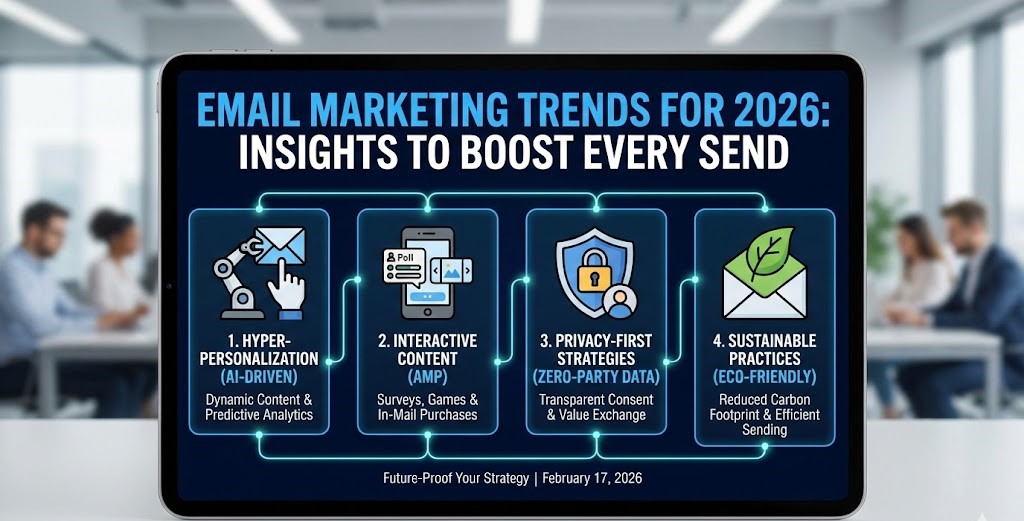
Email remains the trusty workhorse of digital marketing, consistently delivering an impressive average 36:1 ROI. However, as subscriber expectations shift and technology evolves rapidly, sticking to the old playbook will leave your brand behind.
If you are setting your priorities and goals for the year ahead, it is time to look at what is actually moving the needle. Based on the latest State of Email survey data, here are the 7 definitive email marketing trends you need to embrace to boost engagement and maximize your revenue in 2026.

1. Privacy-Proofing for the Long Term
Over the past decade, regulations like the General Data Protection Regulation (GDPR) and the CCPA have fundamentally reshaped data privacy. With the rapid advancement of AI, a new wave of legislation, such as the European AI Act, is emerging globally. It is no longer just about basic compliance; it is about “privacy-proofing” the long-term health of your email program.
How to put this into practice:
- Collect zero-party data: Focus on gathering explicit consent and preferences directly from your customers via preference centers or live polls.
- Remove PII: Steer away from holding Personally Identifiable Information (PII) when possible to protect sensitive subscriber data. Use subscriber IDs instead.
- Adopt Brand Indicators for Message Identification (BIMI): Allow your subscribers to visually verify your brand’s verified logo directly in their inbox to build instant trust.
- Disclose AI Usage: If you use AI to personalize emails, clearly disclose it in your privacy policy or email footers, and provide users a way to opt out.
2. Generative AI for the Entire Workflow
Generative AI (GenAI) has officially moved beyond a buzzword and into daily operations. Currently, 34% of email marketers use AI for copywriting, but its true superpower is massive time-savings. By assisting with brainstorming, subject line generation, proofreading, and image creation, GenAI allows teams to drastically reduce production cycles. Today, only 6% of marketing teams need more than two weeks to build an email.
3. Lifecycle Email Automation
Automation is the backbone of an effective lifecycle marketing strategy. Building automated sequences (like onboarding flows or abandoned cart triggers) allows your team to move from a one-to-one effort to a highly productive one-to-many system. By investing time upfront to build these automations, you free up vital resources to focus on high-impact strategy and creative testing down the road.
4. Rethinking Analytics and Data Management
The way email marketers measure performance changed forever with the introduction of Apple Mail Privacy Protection (MPP). Because MPP prevents senders from knowing if an email was actually opened, relying on “Open Rates” as your primary KPI is an outdated strategy.
To thrive in 2026, marketers must shift their focus to deeper metrics:
- Unique Click-Through Rate (CTR)
- Conversion Rate
- Revenue Per Email (RPE)
- Unsubscribe Rate
5. Email Newsletters as a Powerful Retention Tool
Newsletters are experiencing a massive renaissance, with 58% of marketers now including them in their core strategy. Because only about 5% of your audience is ready to buy at any given time, newsletters are the perfect vehicle to nurture the other 95%. They build long-term relationships, establish deep brand trust, and keep your company top-of-mind so that when a subscriber is ready to purchase, they come straight to you.
6. Embracing Interactivity
Static emails are out. Interactive elements turn your marketing emails into engaging, two-way conversations that allow subscribers to actively participate without leaving their inbox. Top trends include embedding live polls, sentiment trackers to gather instant feedback, gamified scratch-offs to reveal discounts, and animated image carousels to showcase new products.
7. Enhanced Segmentation and Collaboration
More than 90% of marketers report that segmentation directly boosts email performance. In 2026, basic segmentation (like grouping users who opened an email in the last 90 days) is no longer enough. Brands are moving toward enhanced segmentation, tying highly granular behavioral data, demographics, and real-time engagement to specific stages of the customer lifecycle.
Conclusion
Making your email program stand out in 2026 requires a delicate balance of cutting-edge technology and human-centric connection. By privacy-proofing your data, leveraging AI for workflow efficiency, shifting your focus to reliable conversion metrics, and delivering highly segmented, interactive content, you can turn your email list into a powerful engine for sustainable growth.
Also Read : How to Become an Uber Driver or Eats Deliverer in 2026: The Ultimate Guide
